
Movies evolved over time just like any thing else on this earth. First, the era of the silent movies, followed by the era of black and white talkies. Then came the era of colour and now god knows what is next. We also have the animated series of movies and no body can predict what the next generation of movie goers will experience..
One of my area of interests is seeing old, really old movies that are often not shown on any public platform often. These are real classics and must be treated and preserved.
When a movie is made, it reflects the mood of the society at that time. Movies often heal the wounds of depressing times - Charlie Chaplin's finest efforts had come in the time of the Great Depression and the World Wars.
In India, during the early stages of our post-independence period, we saw movies like 'Do Bhiga Zameen', which was about a farmer and his struggle. It was at a time when India could not produce even a safety pin on its own. Then came movies like 'Naya Daur' that showed a new confident India in its stride. Then there were movies made by Manoj Kumar which were made with the slogan 'Jai Jawan Jai Kisan' as their basis. Then the Amitabh Bachchan era, during the emergency times, where an angry youth goes against the system and is not afraid to take revenge came into prominence. India became a very confident country in the later part of the 20th century and our movies reflected them.
What I am trying to say is, when one watches a movie, he or she should look at the movie in the broader perspective and not just criticize the movie based on the story or the acting or even location of filming. We must look at the time the movie was made and look at the mood of the times to actually judge a movie..
One of the finest movies ever made, in my opinion, is the movie 'The Battleship Potemkin'. It was released in the year 1925 and directed by Sergei Eisenstein. The movie is a glorified version of the naval uprising that took place on the battleship Potemkin during the Tsarist regime that took place in 1905. It was made at the time when Russia was at the start of their Communist rule and the movie just brought out the heroism of the soldiers very well. Its acting can be criticized, the technology used(or the lack of it) will make the modern day cine-goers cringe. The haunting background music makes this movie extremely special. This being a silent movie has dialogues appearing as title cards from time to time.

The movie is divided into 5 parts -
1. The Men and the maggots
2. Drama at the harbor
3. A dead man calls for justice
4. The Odessa Staircase
5. The Rendezvous with the squadron
The first part deals with the immediate cause for the uprising. The old meat that was infested with maggots. The seniors of the ship, representing the Tsars have no concern for the majority of the work-force on the ship. There is a part in the movie where the doctor, who inspects the meat, tells the soldiers that 'these are not worms on the meat, they will be cleaned if you yuse brine'. The soldiers offended by this revolt by not having the soup.
The second part - A group of offending soldiers are round up in the corner and a tarpaulin is thrown at them. Then the guards are asked to fire at them. When they are about to shoot, a man rises and asks the guards "to look at who they are shooting, their own brothers?". This starts of series of unfortunate events in the ship where the captain of the ship and most of the senior officers get killed.
The third part - Here the man who began the uprising (The man who stopped the massacre from happening) is killed. At this point the ship reaches Odessa in Ukraine, where the word has spread of the uprising. The dead man is kept at the harbor, where the people of Odessa gather and pay tributes to him.
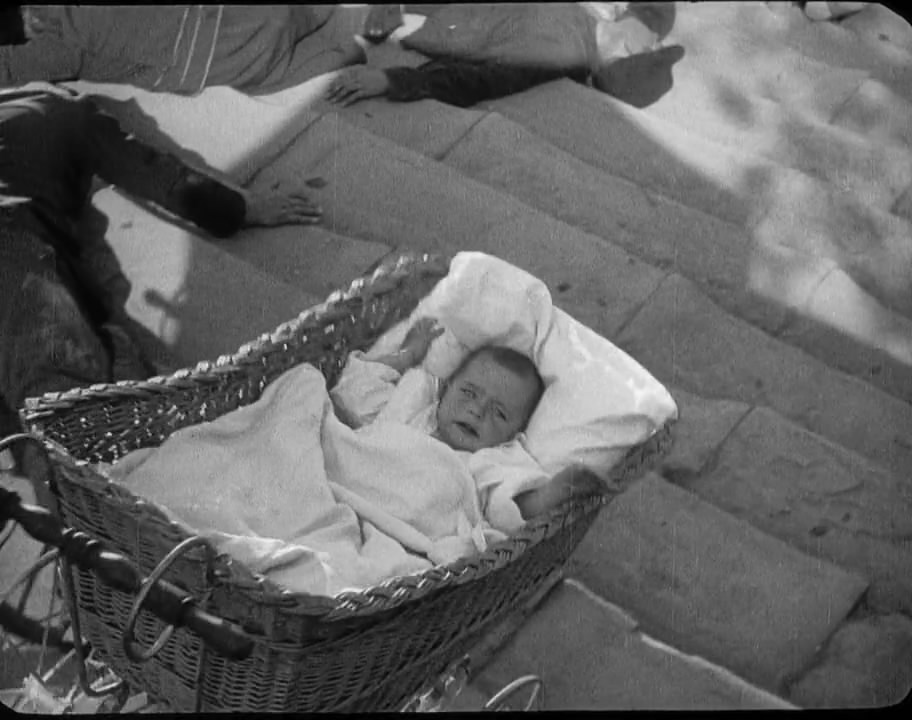
The fourth part - This is the most famous part of the movie - The Odessa Step sequence. Here the people of Odessa who had gathered at the harbor, are shot by the Tsar guards. The steps are almost never-ending and this massacre is shown brilliantly. This event never occurred, but was included in the script just to show, how bad the Tsarist regime was. Towards the end of the sequence, the soldiers shoot a mother who is pushing a baby carriage. She falls to the ground, and as she dies she accidentally kicks the carriage away; it rolls down the steps alongside the frightened crowd.
The Fifth part- This shows the retaliation by the soldiers of the Battleship Potemkin.
I would give this movie 10 on 10. The beauty of the movie is that, despite the fact that there is no dialogue, you still get the message that the director is trying to tell.
Movies reflect the time in history that they were made in. Great Movies tell a great story about that time. Battleship Potemkin belongs to that category...

No comments:
Post a Comment